Showing posts with label home birth. Show all posts

Friday, March 20, 2015

Birth Story {Home birth of twins with a skilled midwife}

Last week I shared with you Jeanelle's journey to home birth for her twins, and now, the much anticipated birth story.

Devastated to learn that being pregnant with twins might ruin her chance at a natural birth, this mother followed her instincts and pursued every option until she decided to birth at home. With the help of an independent midwife and the support of her partner and a doula, she had the birth of her dreams. With twin A breech and a cord prolapse handled by a skilled midwife, Jeanelle, a family physician in Illinois, defied all odds and birthed two beautiful babies with zero subsequent complications. 


We met with the midwives once and I felt immediately comfortable with them as a team. I felt so blessed to have another option other than cesarean section for my twins’ entrance into the world. The midwives were confident that I would deliver vaginally but also explained that if things did not progress normally at home that I would be transferred to the local hospital for a cesarean. I prayed the home birth would be successful and transfer would not become necessary.

In the next week my husband and I prepared for our birth – we set everything up for the twins and shopped for the birth supplies. We felt funny purchasing shower curtains for our bed and cookie sheets for instrument trays but we felt we were doing the right thing for me and our twins. I continued to see my OB provider for check-ups and antenatal testing (ultrasound for biophysical profile) but did not share with her my home birth decision since she would likely not agree and would remind me of the extreme risk I was taking when I was confident in my decision and trying to stay positive as my due date approached. She did agree to let me wait for labor to begin before performing the cesarean since I refused to schedule a cesarean in advance of labor. I was very nervous and often doubted my ability to birth my twins at home in the week leading up to the birth but I prayed and trusted God to see me through.

At 2:45 am on Ash Wednesday morning at 38 weeks and 2 days, the day after my last ultrasound that again showed my twin A to be happily breech and about the same size as his vertex sister I started having contractions as I lay in bed. I got up and went to the bathroom 3 times before I was convinced that this was real. I labored until 3:15 am then I began to feel leakage and knew my water broke. My previous two labors ended with my water breaking so I had never experienced membrane rupture this early on. I was Group B Strep positive so I knew I had to have these babies soon to minimize the risk of complications from that. The contractions were getting more intense and closer together, about every 7 minutes now so I woke up my husband at 3:30 am and called my doula and midwife at 4 am. I felt that the twins wouldn't come for a while so I told my team to take their time, they arrived about 6 am and the contractions had intensified more and were every 3 minutes and lasting at least a minute. I continued to leak fluid. I was informed shortly after my midwife arrived that her preceptor with twin and breech experience would not be able to make it to my birth because she was attending another birth close to her home, an hour and a half away. I was terrified but prayed and felt peace that God would work it out. My midwife, her student, and my doula were believers and also trusted that all would work out and my midwife agreed to assist me with delivery alone if necessary. I continued to labor in my kitchen holding onto the counter as my husband applied heat to my lower back (my labors are always in my back). A short time later my midwife announced that a substitute experienced midwife had been found and was on her way from the next state to attend my birth. I was nervous to have someone in my home helping me give birth who I had never met, but again I trusted God to work things out. The substitute midwife arrived about 9 am (she just happened to be on her way to an orientation closer to my home then her home and it was snowing that morning so it took her twice as long) and I liked her immediately. She was calm, confident and kind.  At this point I was laboring in my large bathroom standing at the sink with my husband and doula applying heat and massaging my lower back, the contractions were much more intense and I was starting to feel pressure. My doula was feeding me a banana and making sure I was drinking water; this was so much different than my previous two hospital births where I was not allowed to eat or drink or move around as I pleased. The midwife and her student came in periodically and unobtrusively checked fetal heart tones which continued to be strong. The midwife offered to check my cervix for dilation but was supportive when I declined since I was Group B Strep positive and felt that things were progressing well – this also was in sharp contrast to my previous hospital births. I was in pain but actually enjoying the relaxed atmosphere of my own home and a natural minded birthing team. If my twin A had been vertex and I had had a hospital birth I would have had to labor in an OR without my doula and with a huge team of people watching me just waiting and ready to start a cesarean if something didn't go according to their plan.

At about 10:30 am I felt the urge to push, my doula notified the midwives who were in the other room allowing me to labor in peace. The midwives and the midwife student came in calmly and began setting up the birth and baby equipment. I had been laboring fully clothed in my pajamas so they recommended I undress from the waist down at this point, definitely different from the hospital where I would have been laboring strapped to baby monitors, in a hospital gown and hooked to an IV.

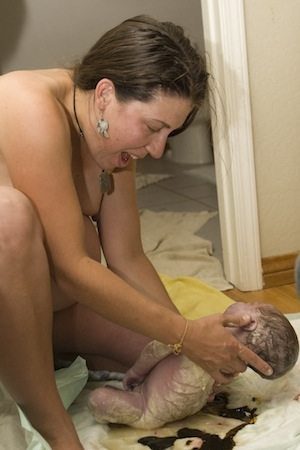
I undressed and got on all fours as recommended in the breech birth book I had read in preparation for this birth and felt my body start to push, my midwives told me to do what my body told me to do so I did. It was amazing – not pushing to the count of ten, no lithotomy position, only my body doing what it needed to do to birth these babies. After the second push the midwife with twin and breech experience calmly but urgently stated that she saw cord and needed me to either squat or get on my back to push my breech baby out as soon as possible. I quickly was assisted by the midwives and my husband onto my back, the midwives reported they saw a foot and they insisted that I push this baby out now since he was not getting any oxygen since they could not feel any cord pulsations. I was scared but confident that I could do this and that God was with me. I took a deep breath and pushed with all I had in me. I felt an intense vaginal pain which I found out later was the experienced midwife helping to pull baby A out by his foot, then I  felt my baby boy enter the world at 10:45 am. The midwives quickly placed my baby right next to me, keeping his cord intact (this would have never happened in a hospital situation, they would have immediately cut the cord and whisked him away) and began resuscitation since he was not breathing. I was calm remembering that the breech birth book had said breech babies are often slow to breath as a protection for them since their head comes out last and it wouldn't be good for them to take a deep first breath when they are still in the birth canal. As they were bagging my baby boy I heard little whimpers then a loud cry, I praised God! The midwives placed him on my chest and my husband and I cried tears of joy. The midwives quickly got to work again listening to twin B's heart rate which sounded good and checked her position externally, she was still vertex. As I was enjoying snuggling with my precious baby A I began to feel intense contractions and knew twin B would be coming soon. I handed baby A to my husband and was helped up to labor and deliver in the position of my choosing to birth baby B after my husband cut baby A's cord. I was squatting and leaning over the bathtub when my body began to push. I got into a semi squat position and on the next push my baby girl was born head first at 11:05 am, 20 minutes after her brother. My husband cut baby B's cord after I had had a chance to snuggle her for a while, then the fused placenta delivered without a problem. I was sitting on my bathroom floor holding my precious twins in my own home with a wonderfully supportive birthing team and my husband by my side just praising God for his faithfulness! I did it! I delivered twins with a breech twin A at home and we all were fine, even after a cord prolapse! It was a miracle!

I was helped to my cozy bed to rest and nurse my twins as the midwives cleaned up the bathroom. My doula fed me breakfast and I was allowed to take my time bonding and nursing before the midwife did the newborn exam and showed me the placenta. I was not rushed as I would have been in the hospital, I did not have an IV or a blood pressure cuff in my way. I did not have a surgical wound, a urinary catheter or numb legs as I would have had if I had had a cesarean. Even though there was a complication, I was so glad I had decided to have a home birth. It went perfectly. My twin A weighed 6 pounds and was 20.5 inches long and twin B was 5 pounds 12 ounces and 21 inches. The midwives and my doula stayed with me for hours after the birth helping me with nursing and answering all my postpartum questions. I had a normal amount of bleeding even though my OB had warned me that hemorrhage was likely after a twin birth and I would need IV Pitocin. My husband and I enjoyed our first day with our twins in the comfort of our own bed, in our own home.

My recovery went very smoothly, the midwife returned 2 days later at my convenience to check the babies and me, we didn't have to be bothered at 6 am by doctors checking me and the babies and nurses checking vitals all night long. Nursing went great and the babies did not have excessive weight loss or more than normal jaundice. The midwife scheduled her next visit for 2 weeks later; she would return to my home to see how I was recovering. I didn't have to leave the house at all until the babies’ first pediatrician appointment at 2 weeks old! My experience was nothing short of amazing, I do believe my birth was a miracle and I am so grateful to my husband for supporting me in my decision to have a home birth to avoid an unnecessary surgery and to my birthing team for being willing and skilled to assist me with a home twin breech birth!

Can't get enough? Here's another beautiful birth story of a footling breech born vaginally in the hospital! 

Friday, March 13, 2015

A Family Physician's Path to Home Birth

Today, I'd like you to meet Jeanelle, a family physician in Illinois. Her story of finding out she was pregnant with twins and the challenges that came with that is nothing short of beautiful. Sometimes the path to our birth choices is a difficult one. This mom took the time, questioned the norms and navigated the obstacles  to arrive at the best birth plan for her family. 

I always knew I wanted more than one child. I was an only child and did not wish that on anyone; I was very lonely growing up and would often pretend to have siblings to play with.  My husband and I agreed we both wanted three or four children when we got married and I continued hoping that God would bless us with at least that many.
When our son was close to two we decided to try for a third child despite our son and daughter beginning to be very demanding. It took some time and since I was having heavy, painful periods, unexplained nausea and what I worried were signs of interftility we had a work up for endometriosis. My work up was negative, except for high progesterone, however I did not consent to a diagnostic laparoscopy at that point.  

We conceived naturally the month after the work up. When we found out we were expecting we were surprised, excited and nervous at the same time! 

I am a family physician by training so I tend to wait as long as possible to begin prenatal care since I often find myself arguing with my providers about what is and isn't necessary in pregnancy management. My first appointment with the mainstream hospital midwife was at 12 weeks. I decided to go with a midwife rather than an obstetrician for my third pregnancy since I had had two natural hospital deliveries and full term uncomplicated pregnancies. At my first appointment all was well and my exam showed my uterus to be about 12 week size according to the midwife. My husband and I practiced fertility awareness so I knew when we conceived and did not feel the need to have an ultrasound until 20 weeks but the midwife insisted just to "check dates". The ultrasound technician put the ultrasound probe on and just as I was trying to figure out what I was seeing she announced, "Well, you're having twins!" I could not believe my eyes or ears! I never entertained the possibility that I would have twins; there are no twins on my side or my husband's side of the family. I was in a state of shock the rest of the day and I think my husband has been in shock since, he still can't believe we have twins. I was immediately transferred to the care of the obstetrician team at the same clinic since midwives here do not manage twin pregnancies. I had dichorionic diamniotic twins which are considered the lowest risk so I did not have to be referred to maternal fetal medicine/high risk OB care. I chose my main OB provider to be the same one who cared for me during my last two pregnancies.

My pregnancy was uncomplicated, at our 20 week ultrasound we found out our twin A was a boy and twin B was a girl, I was thrilled about that not only because I wanted a boy and a girl so my daughter had a sister and my son a brother but also because I knew I wanted a vaginal delivery and knew my twin A had to be larger than my twin B to convince my provider to let me do that. Baby boys are often larger than girls.  My twin A was vertex at the 20 week ultrasound so I was confident a vaginal delivery wasn't going to be a problem since my provider agreed that a vaginal delivery was possible even if twin B was breech as long as twin A was vertex.

My provider insisted that I have ultrasounds every 4 weeks for twins starting at 24 weeks, I was adamant after doing my own research that starting at 24 weeks was not necessary with my type of twins so my next ultrasound was at 29 weeks. Much to my surprise both my twins were breech at the 29 week ultrasound. I was very depressed during and after this ultrasound since I knew I would be told to have a cesarean birth if twin A did not flip to vertex soon. I immediately researched natural ways to flip a breech baby, focusing on twin A since twin B's position didn't seem to matter to my provider since she could change positions after twin A was born. I started chiropractic care with a wonderful chiropractor in my area trained in the Webster technique. She was confident my twin A would flip however she admitted that she didn't have twin experience. I was worried but pretty confident at that point that twin A would soon be vertex. I continued seeing the chiropractor twice to three times a week, doing inversions and pelvic tilts as I'd seen on spinningbabies.com. 

Once it was confirmed at my 33 week ultrasound that twin A was still breech I tried moxibustion, swimming, music and my husband talking to our twin A to encourage him to flip but nothing was working, twin B was vertex and twin A still breech at our 37 week ultrasound. At this point I began to accept that twin A would not be flipping but would stay breech likely due to lack of room with his sister in his way. 
I struggled with anger at my body, God and even my precious unborn baby for forcing me to accept a surgical birth. After much prayer, research, and discussions with my husband, supportive friends, my chiropractor and natural twin moms on Facebook I decided I wanted to try to have my twins vaginally even if my twin A continued to be breech, he was in a complete rather than a footling breech position and I had had two prior vaginal births to babies larger than these twins likely would be. 

I was convinced after much research that the Term Breech Trial that convinced the obstetric community to stop doing breech vaginal births, was overall a study with many problems and follow up studies did not confirm the findings but rather showed that vaginal breech births may be just as safe as cesarean births for breech babies and safer for the mothers.  

I hired a doula and wrote up a birth plan. Since I work part time in the same clinic system as my provider I decided to email her to tell her my plan rather than wait until my next appointment. I explained my reasoning to want a natural birth rather than a cesarean even though twin A was breech. She took her time getting back to me and when she did, she made it very clear that she and the rest of the OB team that may attend my delivery would not assist me with a breech twin A birth due to the risks to the baby (she named them all including twin interlocking, a very rare complication which she said was unique to my twin's positions- breech/vertex) and their lack of training with breech vaginal births.

Up until this point I was thinking even if my provider did not agree to let me try a breech birth I was going to labor at home as long as I could then show up at the hospital pushing and refuse a cesarean. She asked in her email response that I not put her or her colleagues in a difficult position where they must do something they are not comfortable with. Since I work at the same clinic and would have to face her again, and I didn't want someone that  uncomfortable with breech vaginal birth attending my birth in case my baby needed assistance, I decided there was no way I could do that now. My provider did offer to refer me to another local clinic's maternal fetal medicine department since they likely had more experience with high risk birth but she said they would recommend the same thing she was recommending, a scheduled cesarean section at 38 weeks. I decided not to go with this referral after I found out that they would be doing a 2 hour ultrasound at 37 weeks for no apparent reason other than policy and if I delivered in a hospital with an OB their breech experience would be limited since the hospitals here in Central Illinois do not allow planned breech birth and my birth would be very managed. My research showed that the complications in breech vaginal birth are caused mainly by errors in the management of a breech birth not the mode of delivery itself. I figured at this point I had no other option besides cesarean or so I thought.

In my devastation I was talking to a close friend of mine who values natural birth as much as I do; she reminded me that she had a home birth with an independent local midwife with her second child. I had never entertained the idea of a home birth, I didn't think it was safe, being a physician myself with some obstetric experience, and I did not think my husband would be supportive.  Since I realized I had no other option at this point if I wanted a natural birth I looked into it. Independent midwives are not recognized in Illinois, in fact home births are just short of illegal. I was already 37 weeks along so it was unlikely I would find a midwife who would be available and willing to take my case. I prayed that if this was where God was leading me, it would all work out. The midwife took two days to think and pray about it before agreeing to take me on, she had no twin experience and very little breech experience. She told me she had a preceptor who had been in practice for over 30 years and had a great deal of twin and breech experience but she doubted she would be available at such short notice. Much to our surprise the preceptor was available and willing to take my case! 

I knew at this point this was God's answer to my prayers for twin A to flip to vertex. I finally had peace and no longer felt angry that my twin A was persistently breech. I remembered that God does not always answer prayers the way we want Him to, but he does promise to work things out for good for those who trust in Him. So we planned the home birth, my husband reluctantly wrote the check for $3300 to cover the home birth and the two midwives. We are on a strict budget since I work part time and do not get paid when on maternity leave so this was tough but we knew it was worth the sacrifice we would have to make. We met with the midwives once and I felt immediately comfortable with them as a team. 
Up next: The Birth Story 

Monday, November 11, 2013

Birth Story {The Freebirth of True}

This November, we are sharing birth stories at the YC Birth Circle meet ups! I just couldn't wait to share this beautiful story with you, so here it is. And be sure to check out the birth video of 

The Freebirth of True.

He was “due” only the day before, but since all the others were a bit early, it was the longest I have waited! Typical 6th baby; nights of contractions leading up, but they’d quit by morning and I’d wake up pregnant. I got the feeling time and time again that it would be a slow build up to labor, and even though I “wanted” a super, quick and easy birth, I wasn’t so sure I would get it.
Went to bed on May 18th with the typical run of contractions, although more pressure than normal. Stopped somewhere through the night, and started up again at 5:30 am on May 19th. Somewhere in me I knew this was the beginning of “it”-but I had no idea how long it would last and if this babe would come today or even tomorrow. It just had that “different” feeling, even though the contractions were totally irregular and would even stop for 15-20 minutes at a time. Kind of how my fifth labor started out, but even less predictable. Still no mucous or blood or anything to reassure me, so I just went about my day as best as I could.
At about 2 pm, I laid down in bed with Belgium to see if I could rest. It was difficult to remain still during contractions, and I thought, “Really? Already?” True always liked to hang out on my right side but at this precise moment I felt him move forcefully to my left side. Literally minutes later the contractions got more regular.
By 4 pm, I knew this was “it” but still not predictable. However, the pressure was increasing. I knew I didn’t want a midwife there, but I did want my friends in addition to my husband. I called my friend Margo to come and also my friend Jenni who is a pro photographer. I hadn’t totally decided if I was comfortable with pictures but I thought she could come for now at least…with both of them I hated having to make the “phone calls” (even though I love them both!) just from that element of feeling like people would be here “waiting” for me. (And not that they felt that way at all, that’s my own baggage!)
They arrived shortly and left me to my business of laboring. I labored outside on at least 3 of our decks, downstairs, upstairs and was very pace-y. I used the large tub in our bathroom, listened to music, listened to hypnosis. A lot like how I live, actually. Always busy, never resting, always on the move.
I wasn’t uncomfortable. In fact, several times, I thought it really wasn’t painful or awful or unbearable at all. I just kept needing to change my coping tactics, and even so, that was working fine. My midwife brain would look down on myself, as much as I was trying to stay out of that analytical brain-I couldn’t help it! The paranoid side of me felt like WHY was this taking so long (even though it really wasn’t) even though I knew deep down everything was normal and fine. There was nothing wrong at all, my baby and I both were doing perfectly. The only problem was my expectation or hope that the labor would be shorter, or needed to be for a 6th baby. My midwife brain assessed the situation as normal too; I watched myself deal with longer and stronger contractions, I never listened to baby but I felt him move and knew he was doing fine.
By 6 pm, I knew there was no going back. I labored in the bathroom (my sanctuary) quite a bit. Even brought my computer in so that I could put on music. Lit a candle and filled up the jacuzzi tub to see if that would help. It was getting a lot harder, but I remember thinking I wasn’t as physically close as I would like; mostly because I wasn’t minding hearing the music and I was still able to text on my phone! However it was getting rough and I was still wrestling with this idea that things should be moving so much more quickly than they were. My expectations were causing me undue fear. At one point, I even asked my friend Jenni (the photographer, although she has birthed 2 babes) if this would be over soon. All I wanted to do was get this baby out and hold him. It just felt like the longest time to wait and it wasn’t getting anymore comfortable.
I was starting to feel a little grunty around 7 pm…but definitely not full on pushy, in fact it came and went. My midwife brain just told me it wasn’t time yet, no worries. I got this feeling of surrender and just told the baby I was giving up all control; he could do what he needed to do with no fight from me. I was laboring in my room alone, when at 7:30pm I gave a tiny push and my water BROKE all over the wood floor. In all the births I’ve attended, I have never seen that much water. It was clear, and it gave me the courage to go on, knowing that it couldn’t be too long now. (I’ve never had a labor where my waters opened this early. With all the others it has been as I was pushing, and so this was new. I realized later that it definitely added to the physical intensity that was to come. When it happened, all I could think was, “Good! It shouldn’t be too long now!”) I was also able to see outside myself a bit and recognize what’s “normal” for me at this point- I was feeling shaky, and looking for reassurance that I could indeed do this. I’ve done this with every baby I’ve had, and I saw the humor in it this time.
About 15 later, I started to push involuntarily, but again not with every contraction. It would either feel really good or really not good. I had “planned” (along with my hope for a quiet, fast and peaceful birth!) that I would not push this time, but rather hope and pray for the fetal ejection reflex. I had experienced that with my 4th and 5th births, and although it was a scary sensation, it was so much less effort and trauma than my previous births where I really, athletically pushed. But this baby was asking me to push. I listened to this voice, and followed it. Lesson learned (again); being stuck on a vision of exactly how you think your birth should go generally isn’t helpful.
At first it felt really good to push-but after 20 minutes or so I began to feel frustrated, like nothing was happening. My brain went into fear mode again, and I panicked. I feared this baby wouldn’t come out-that everything I believed about birth maybe WASN’T true and that I would need help I couldn’t get. I was pushing and pushing, attempting to focus but feeling utterly defeated. I had never, ever, in 5 births felt this way before. Sure, pushing hadn’t always been pleasant (my second came out with his hand next to his face-that makes for some painful pushing!) but this was downright frustrating. My brain kept saying maybe this is not normal for a 6th baby- and I was caught in the crux of my own issue. Because if I HAD had a midwife there, it’s likely I would have felt from her that maybe this WASN’T normal. Then where would I be? Instead, I cried and asked my husband to encourage me. I knew at that moment that it was up to me. I wanted this baby out. But the only way was for me to get him out. I felt my fear, very real. I am sure I looked it, too, for at least a second. I took some deep breaths, some Rescue Remedy and knew I must move on. This baby was coming out hell or high water.
After pushing in the tub, I hopped out quickly and I grabbed my bed and went into a deep squat, pushing sort of wildly. Jason supported me so wonderfully, just quietly whispering that I could do it, that I was almost there. But still, no head. Not even a sliver.
The deep squat was killing my legs. I am not a squatter and so I laughed later ay my choice of position. However, I made it into the squat quite well at the moment and remembered instinctively that I must have needed whatever extra space that afforded me. It was both terrifying and relieving-my body felt out of control with these pushes, yet I was SO determined to hold him. I don’t remember in previous births caring that much about the baby at this point in labor, but in this one, it was what kept me going. With every push I visualized his head moving down and I kept seeing and feeling what it was going to feel like when he was out. It was either that intense visualization or giving into my fear that I was not going to be able to do this.
Still not feeling like I was making progress, the baby passed my rectum (we all know what THAT means!) and I took it to be a good sign. Then the slight burning up inside, good. With the next push I felt that inexplicable feeling as the head starts to fill up that space, and then grows. I felt the wrinkled part of his scalp as it rolled forward and was amazed. It was happening. I pushed with the next push for a lot more of his head, and then used all the patience I had left to just leave the rest to my body, all the while standing and supporting my body and his head with my hands. I was almost there, deep breath, I could taste it.
With the next contraction the rest of his head slipped out. I asked for a mirror to check his color but mostly I wanted to see his precious little face!! I leaned forward onto the bed, his head out, just waiting. I remember Jason telling me something-I realized later he was just encouraging me but at the time I thought he was wondering where the rest of the baby was. I muttered something about needing to rest, and I felt the baby rest too as he shifted and negotiated his next and final move out.
home birth, unassisted birth, birth circle
As I felt the next and last contraction surge, he rotated, some fluid spurted out and I reached down to catch him even though I couldn’t actually see what I was doing! As soon as he was out I bent with him to the floor; placed him down for just a second before I picked him back up again and smothered him with kisses. THE moment I live for and the reason I’ve birthed 5 times and love to watch other women experience the same! The smell and taste and goo of vernix and fluid were everywhere-on my lips and nose and I kissed him and talked to him. He had pooped on the way out, so I was covered with that too, but he was alert and coming around really fast. It’s amazing how the instinctual things a mother will do with her baby at birth are also exactly what the baby needs!
I was so relieved.  And so proud and happy. And now so sure that following my heart was what I needed to do-even though it was a challenge. I delivered my placenta within 5 minutes or so, hardly bled at all, and was just generally in shock with the enormity of the whole experience.
I see True’s birth as perfect-not because I didn’t have anything to deal with, but because I did. Conquering my fears, my demons from the whole entire last year was the theme of my life-of this birth. There was no was of escaping it, or knowing how it would play out, exactly. But it was there, and I am that much braver and more confident and trusting on the other side. That I am truly powerful; that I can do anything. That I know what I believe about birth.
True’s birth has given me a whole new confidence; after 5 kids I didn’t think myself unconfident, but I’ve been shown how much farther there is to go. I am complete trust, in complete trust of this tiny person that has shown me. Experiencing True’s labor and birth has been a profound teaching gift for me. We needed to do it the way we did; and not a smidge different or a moment sooner or later. It was the most PERFECT birth; in so many ways, much more sophisticated with it’s teachings than anything else I have experienced. With it came peace about the rest of my life right now; that I know who I am, what I want and where I am going. I know what I believe and birth and the women I serve. I know where I belong and where I do not belong. And for this, I thank this babe.


I hope you enjoyed this beautiful birth story just as much as I did. Read the intro to the story and watch the video on the birth stories page of Indie Birth.. 

childbirth education, podcasts
Click here for more information!
Maryn Leister is the founder of Indie Birth Association, dedicated to serving mothers and babies and supporting empowering birth experiences.  She is a Pastoral Medical Provider and author of Taking Back Birth, podcasts. 


Thursday, September 12, 2013

Unplanned Unassisted {via Banned From Babyshowers}

Banned From Baby Showers: Indiana Couple Gives Birth in Their Bathroom -- ON ACCIDENT! (It's a Better News Story When it's Not Planned)

Donna Ryan, author of Banned From Baby Showers presents a great alternative title for "Emergency Childbirth"; as you might remember from another recent post of mine, semantics are incredibly powerful!

My favorite part of her post is her commentary on the response of the OB
that he'd never seen a baby born in "this good of shape born outside of the hospital".  He/she must have some magical powers to make babies be in "good shape" when they are born in the hospital!  Being born in the hospital does not mean that a baby will be in "better shape" than a baby born outside of the hospital. It's not a magical place.
It's a shame the shock value of this story - a shame that "it's a better news story when it's not planned" because every birth is beautiful whether it be at home, at a hospital, unassisted or attended by a professional. I would not consider an EMT one of those professionals and I cringe at the misinformation they are taught in school. My husband is on his way to becoming a firefighter and happens to be in the paramedics course this semester- let's just say that the "emergency" childbirth chapter of his school book is filled with sticky notes from me! Not only are they taught inappropriate ways to attend to an unplanned unassisted birth outside of the hospital but some of what they are taught can be down right harmful, if not at least traumatizing to the mother and un-beneficial for the baby. 

Banned From Baby Showers suggests that this couple, though they esteem this as a positive experience, may venture to opt for an induction for their next baby. I would like to hope they'll opt for a planned home birth.

Where was your baby born? Did you have an unassisted birth? Planned or unplanned?

For more information on [planned] unassisted birth visit Laura Shanley's Page 
or take an "undisturbed birth" class with Indie Birth 

Be Empowered on this Journey of Life!

Monday, July 8, 2013

Final Rules for Midwifery Scope of Practice and Licensing

Just so that you're all aware: The Final Rules for Midwifery Scope of Practice and Licensing in Arizona. Effective July 2014. -via Arizona Department of Health Services, filed rules

Wednesday, July 3, 2013

Don't Hate, Let's Educate {Birth}


Stop the Mommy Wars is derived from the concept that the only choices we have control over are our own. What another mom chooses is her decision – who are we to judge that?  We are each free to make our own decisions and we should support another mother in her own decisions, creating a stronger community.  While I fully believe this is an excellent idea to stop the growing trend of pop culture pitting moms against each other, I also feel we have other battles placed in front of us that must be confronted. So should we fight one another, insisting that each person is in the right? No: Don't Hate, Let's Educate.

Birth
Your birth, your way. I firmly believe that and as a doula abide by that; I support whatever kind of birth my client chooses.  Here's the catch- I educate my clients. They are making informed choices.

The problem lies, once again, in our misinformed culture. Fear is rampant!  Less than half of all expectant mothers will have taken a childbirth preparation course by the time they give birth. A good majority of those who do take a course take one in a hospital setting. In a hospital course you learn how to be a good patient. You learn some basics about the stages of labor but not what you need to know; not evidence based birth. You'll learn what your [medical] pain management options are but most won't tell you all of the risks of an epidural or that a doula helps to relieve your pain naturally and is associated with a more positive birth experience. They'll tell you the process of admitting you to the hospital but not tips to keep your labor from stalling; they have pitocin for that. They don't work to undo the fear that has been bestowed upon us by our pop culture and the collective memory we've built from that culture.  It's easy and cost effective when birthing mothers can be put into the system, boxed up and released.


But we are each individual mothers with unique births, bodies and babies- we deserve to be treated as such. Don't Hate the system because it treated you unfairly, Let's Educate and spread the word that this is a human rights issue; autonomy of choice. This is what I'm talking about!
home birth, gentle birth, birth quotes
A cause that directly affects the health and well-being of millions of women around the world. That cause is human rights in childbirth.
You, mother who doesn't research and just does as your told in the birthing room, I judge you. I judge you and I apologize for that but if we are to take back birth then there is no room for mothers who don't care. We need all the support and advocacy we can get because birth matters.

So is this OB vs Midwife? Hospital vs home? Technology vs nature? No! We can all respect one another. I will respect your choice to birth in the hospital with an epidural if you respect my choice to birth at home without drugs. I respect yours because I've researched yours. Have you researched mine? I'm not asking if you believe it, I'm not asking you to achieve it. I'm simply asking you to be informed. Understand that home birth is a safe option for a healthy, low-risk mother. It's OK if it's not the choice for you, I don't judge you; I simply want you to know that pregnancy is not an illness. I want you to know the epidural is not free of risks. Do you know the benefits and joy of natural birth? Or are you overwhelmed by fear of the pain we have been programmed to expect in childbirth?
"So many North American women have experienced the pain of labor, and then had an epidural, that our collective memory about birth is now full of hurt but is missing the feelings of ecstasy and success that natural birth provides." -Cynthia Gabriel

Our culture has been programmed to fear birth. When birth moved out of the home and into the hospital it became a mystery. Little girls no longer see birth as a normal part of life but as an illness that needs medical care. Everywhere you turn you see complications and pain and no mother wants to be the only woman in the birth circle talking about her blissful or ecstatic birth. Are you getting your information from the media? Are your friends, coworkers and complete strangers bombarding you with horror stories? What would happen if you surrounded yourself with positive birth stories? Have you considered finding a birth circle? Do you have a doula or other caring support persons?
childbirth education, preparing for birth, doula, midwife, 

Midwives may provide an excellent source or childbirth education but if you're getting your information from an obstetrician, you must understand that they are trained surgeons; they are trained to manage complications in birth! Don't be ignorant when choosing your care provider. Do you know your care providers birth philosophy? This should be one of the first questions you ask when in search for a care provider. You shouldn't have to settle or compromise. [<--Trigger warning]
Why is it that we get pregnant and call the surgeon! 

The United States spends $98 billion annually on hospitalization for pregnancy and childbirth, but the US maternal mortality rate has doubled in the past 25 years. The U.S. ranks 50th in the world for maternal mortality, meaning 49 countries were better at keeping new mothers alive.

So what's different here than in those other countries? Do they have better technology than us? No. What's missing here, in the United States, is the midwifery model of care. Only 8% of mothers are seeking a midwife for their prenatal care and birth. When are we going to catch on? When are we going to realize that birth is a normal life event. Not only does birth matter, mothers matter! It's not enough to merely say "the baby's healthy, that's all that matters."

There's not near enough of a concern for the rising cesarean rate. Can a cesarean save lives? Yes. Are all  these cesareans we're having necessary- not even close. The WHO recommends a cesarean rate below 15%; anything above that and our outcomes are not improving alongside of the rise in this major abdominal surgery. We are at a national average of 32%.
 

Take charge of your birth. Know what interventions increase your likelihood of a cesarean.
It is NOT ok that we are using pitocin to elictively induce labor.


Daily Med Plus

Don't Hate, Let's Educate. Surely, a mother who knew the risks of induction to her baby and to herself would not choose this. But as a culture, we have made pitocin far too permissible in birth and ignored the dangers of it. Roberto Caldreyo-Barcia, MD said,

Pitocin is the most abused drug in the world today.

We are disregarding the importance of mother nature and creating detrimental affects.
Infographic courtesy of Plumtree Baby


Beyond all of this, it's more than just this moment, this birth; pitocin impacts so much more. Michele Odent, MD first began exploring the desensitization of oxytocin receptors.
Oxytocin is the hormone of love and bonding and human connection. If the oxytocin system is damaged, or a child’s oxytocin receptors become desensitized, the ramifications are huge. Click here to read more about how pitocin impacts can be life-long. 
A recent ACOG survey found that in 43% of malpractice suits involving neurologically impaired babies, Pitocin was to blame. Is this really a risk you want to take because you're uncomfortable towards the end of your pregnancy? Of course not! But mothers are not being told of the risks and so we are overly seeking convenience. This "convenience" is affecting us as a society. This is what I am so angered by. I don't know your circumstances, I don't judge you; what I judge is ignorance. What I am enraged by is the lack of knowledge and respect for choices made surrounding birth. Why is this risk such an easy option to obtain but to VBAC you have to fight? You'll be told the risks of that and you'll be told in a way that makes you fearful, regardless that a vaginal birth may be a safer choice.
Fear mongering is not ok! Ever!

In conclusion: we must respect each women in the choices she makes for her birth and understand that she made the choice she felt best with the knowledge and support she was given. Don't Hate, Let's Educate. We need to stop bashing one another for the choices the other has already made and start reshaping the way our culture views birth. If we can influence the way we think about birth- trusting mother nature, understanding this normal life process- we can begin rethinking our choices and positively influencing future generations. But with so much negative influence from pop culture and a lack of prevalence in the midwifery model of care, where is a simple consumer to begin improving birth? [<---The answer here.]

Previously in Don't Hate, Let's Educate: Vaccinations and Baby Feeding
For more in evidence based birth to help you make informed choices, follow the Journey of Life.

What's important for your birth ?

Wednesday, March 20, 2013

Why the wait? {Delayed Cord Clamping}

Delayed cord clamping is all the rage - but why?

Skin to Skin

Along with immediate skin to skin contact, the blood baby receives from the cord aids in stabilizing her temperature.  Furthermore, if baby is still attached to you, the chance of a nurse whisking her away to a warmer for typical newborn procedures is minimized.  Besides her blood, you may also want to let baby keep her vernix; avoid/delay the baby bath.  Like blood, vernix also can help regulate body temperature and has antibacterial properties, as well as being natures best moisturizer so it is best to rub this slimy cheese-like substance into the skin rather than wash it away.

Blood Flow

At 1 minute after birth approximately 80mL of blood is transferred from the placenta into baby.
At 3  minutes after birth that becomes approximately 100mL of blood according to the WHO.

Delayed cord clamping is defined by waiting about 3-5 minutes after birth or until the cord stops pulsating.


 Cord just after birth- still pulsating with blood.


Limp cord- blood fully delivered to baby.
Photo courtesy of Perfect Chance Photography

So why is this important?


Baby gets much needed iron supply.  According to Michelle Roberts, a BBC Health Reporter, iron deficient anemia is "a significant health problem because it can harm a child's brain development."  Allowing a child to receive the full potential of blood and iron stores meant for him ensures a good start; "babies with delayed cord clamping had better iron levels at four months of age." (Roberts, 2011)  This iron supply is especially important in premies who may have not had those last 8 weeks in utero to store up iron.

The brain is afforded some extra protection with this blood flow.  In babies with complicated births, especially a lack of oxygen, this layer of protection is crucial to the brain.  Oxygenated blood travels through the cord to the baby helping to prevent hypoxic injury and associated long term problems due to lack of oxygen.  
Elizabeth Perry describes a birth in which 
the baby was resuscitated physiologically through the intact, unclamped cord.
Perry, E. (2012). Redefining Normal. In N. Halseide (Ed.), Second Stage: The Pushing Phase of Labor, Midwifery Today, Inc. 
 -A highly recommended read from this Collection of  Articles from Midwifery Today Magazine.


The Count

A full-term newborn has an average of 120 ml of blood per kilogram of body weight, or an average of a total fetal-placental blood volume of about 480 ml (16.9 oz.) At any given time about 70 % of his blood is in his body and 30 % is in the placental/cord unit.
- Frye, A. (2004). Holistic midwifery. (Vol. 2). Portland: Labrys Press.


In premature babies and babies born to mothers with gestational diabetes these are very significant numbers. By receiving his full quota of blood, your baby is less likely to have low blood sugar and an increased count of white blood cells means better ability to fight off infection.

Q- Even in uncomplicated births and healthy babies, why not allow the baby the blood belonging to them? 
Jaundice is a commonly heard response, however studies show "no evidence of adverse affects from this."  Studies have shown that jaundice and polycythemia are not curbed by immediate cord clamping as there are other factors involved in their derivation.
A- Cord banking may be the only accurate answer to that question. More on this here.  The chances of a low-risk baby needing his stored stem cells is 1 in 20,000. 

To clamp or to delay clamp? That is the question.  One of the many decisions you'll make for your newborn on the Journey of Life.  What will you do?

Thursday, March 14, 2013

Aquadural

I attended a water birth presentation and listened to numerous stories of how relieving and peaceful labor was for mothers who used water; I would share them but couldn't begin to do justice to their beauty! Is water birth right for you?? If you enjoy baths to de-stress, if warm showers relax you, if you like to swim or just love water in general the answer may be yes!  Do you have to birth in the water in order to benefit from it? No- water is an amazing tool throughout labor; when it comes time to push women will quite often just not want to get out.

Benefits for babe

Babies who are born in the water experience a smoother transition into the world; they are born from the water into the water.  When you labor in the water there tends to be less stress on the baby due less pressure on the umbilical cord during contractions.  The sacred space provided for the mother by the birthing tub also results in a sacred space for the baby- tubs put a bit of distance from everyone else allowing for more intimate bonding while still being accessible enough for assessing their health and assisting in birth if desired.  Being born in the tub may make it more possible for mom or dad to 'catch the baby.' 

Benefits for mom

Pain relief- moms describe getting into the water as instant relief.  The Water decreases the pressure of the contractions and provides relaxation, even decreasing the length of your labor.  Some women describe this natural form of pain relief as an "aquadural."  Mom's who labor in the water are not only more relaxed but they have better mobility due to the buoyancy.  The water provides a natural lubricant and decreases the pressure on the perineum, resulting in less tearing. There is a decrease in the risk of infection because the water holds a sort of sacred space for them resulting in less vaginal exams and intrusions; home births in general have less chance of infection because you are in your own environment.

Benefits for midwife

I was reading an article about water births in Midwifery today about the relaxing warmth and whole body support of water; the best part of the whole article was the Q & A which I must share with you:
Q: Why do you prefer waterbirth?
A: Aside from easing mamas in labor and allowing them the freedom to move about, to control their own space and to catch their own babies, there is the prized easy clean-up you don’t get with a land birth!
--Charlie Rae Young of Barefoot Birth
Do you have a water birth testimonial?  Share your experiences on this Journey of Life with laboring and/or birthing in water here.

Sunday, March 3, 2013

Where is a pregnant woman to go?

Home

A home birth is an excellent choice for a low-risk pregnancy.  Midives attend home births. They tend to have a hands-off approach and trust birth. Licensed midwives take only a certain number of births per month and you can expect individualized care.  You will want to interview midwives to find one whom you share a common view of birth with.  Midwives are trained to attend natural labors and have many years of knowledge passed down to them.  At a home birth routine interventions are avoided and the body’s physiology is relied upon as opposed to technology. Your midwife will bring what is needed to your birth.
Hospital

Hospitals provide a medical model of care relying on technology to monitor patients. If you have a high-risk pregnancy you may need to seek out a physician (OB) and birth at a hospital.  CNM’s also attend births at hospitals.  Interview your care provider to determine what their philosophy is on birth. Technology will be used to monitor your labor and you will be mostly attended by on-staff nurses.  Hospitals provide standardized care for women.  When finding a hospital to birth at, be sure to find out what policies, procedures and interventions are common for them as well as from you care provider.    
Birth Center

Not comfortable with birthing at home but don’t want to go to the hospital?  A birth center may be just the choice for you.  Birth Centers show a reduced incidence in c-sections and provide the midwifery model of care.  Commonly they are located near a hospital in case of emergency. 

Hospital Birth Center

Choose carefully to determine whether standardized or individual care will be offered and what policies and procedures are typical.  These may offer a home-like feel within the same building of the technology.

Frequently, women face controversy from well meaning friends and family when choosing where to birth.  This is a tough predicament for women to be in as most want to maintain their relationships with your family; who wouldn't?- They can be an intricate part of your birth/support team but that's the key, they have to support you. In order to do so you can take the initiative to provide them with evidence and knowledge and reasons to understand your choice but in the end it's your choice and their job, once given the knowledge, is to either support you or hold their peace.

In the 1920's birth in the United States was moved into the hospital.  This move was pushed forward by new and exciting options for pain management during labor, such as "the blessed ether" and "twilight sleep" but like many of today's hospital interventions those were not fully tested when made available to the public.  Today, we are still learning the ramifications of the epidural and having more negative than positive affects from the standardized electronic fetal monitors.  So are all hospitals evil??  No!! Medical interventions such as cesareans, iv's, pitocin and more have a time and place- when complications arise.  When there's a need these medical interventions can be life saving measures for both moms and babies and we are blessed to have access to them; the problem arises when the need for intervention is created by interventions. Hospitals offer technology that may be imperative to high-risk pregnancies; in low-risk pregnancies a hospital might be a good choice for a woman who wants to be nearest to the technology or who is desiring to birth with medication or who simply wants the immediate access to help in the case of an emergency like cord prolapse.

Pregnancy is not an illness!  Michel Odent, renowned French Physician said, "One cannot help and involuntary process. The point is not to disturb it."{Do No Harm} For this very reason many women choose not to birth in a hospital. The Cascade of Interventions is becoming a commonly known phrase, and not just in the birthing community, for a reason. Women who wish to avoid this cascade so as not to create problems in a low-risk pregnancy and birth will hire or doula or choose to birth outside of a hospital or both. A guest blogger on Banned From Baby Showers says,

Looking back, having a baby at home was the best experience possible. We didn't have to worry about the drive to the hospital. We didn't have to deal with any cranky hospital personnel poking and prodding all hours of the day and night. We didn't have to deal with hospital regulations, the nursery, and the list goes on. And I never had to deal with any bloody mess whatsoever!

The U.S holds the one of the highest maternal mortality rates in the developed world. Hospitals did not reduce that number but increased it. Compare us to Holland, where birth is common at home and it becomes shockingly apparent that hospitals are not the safest place to birth. Hospitals have a higher rate of infection, high nurse to patient ratio and many protocols that treat women like cattle rather than individuals. That may sound harsh but they are required to follow standardized care for all women regardless of individualism and that creates added risk in an uncomplicated birth. The nurses in a hospital rely on machines, that were introduces before fully understood, to monitor labor. In America our cesarean rate is 32% while the WHO recommends below 15%. You can research hospitals in your area to see their individual rates but the numbers hash out to 25-30% of women who give birth in a hospital setting end in a cesarean compared with 6% of those who choose a birth center to give birth in.

Birth Centers are licensed and/or accredited by ACOG as safe places for giving birth. The care provided is individualized; laboring mothers are closely watched and the midwives who watch over them are trained in knowing if a complication is beginning to arise. Instead of being monitored by machines, women in birth centers are watched over by their care providers. Birth centers have a transfer rate of 2%, the majority of which are non emergency transfers and can commonly be for prolonged labors that end in vaginal births. The risk for infection at a birth center is higher than of that at home but significantly lower than that of a hospital. Accredited birth centers have emergency medical equipment on hand and sometimes even a house physician. Accredited centers also have agreements with hospitals in case the need for a transfer arises and it is possible that your midwife will have privileges at the hospital of transfer resulting in no interruption of care.

Even more important than where you give birth is who you choose to attend your birth. Midwives are trained in birth, OB's are trained in medicine. That doesn't go without mentioning some midwives are extremely medicalized and some OB's are great at sitting on their hands; what's important is to find a care provider with a birth philosophy similar to yours who will be there to support the choices you make.  This alone is evidence to the safety of home births.  Home births are attended by midwives who have earned their degrees and/or license by their training, knowledge and experience.  This title wasn't handed over to them lightly, they worked for it and birth is their passion.  A good home birth midwife isn't out to manage your labor and deliver your baby but to walk beside you and support you in your pregnancy, labor, birth and postpartum period.

You birth your baby- where you choose to do this is your prerogative.  If you're most comfortable in your home, in your bed, with your comforts and surroundings, then in a low-risk pregnancy this could be the best choice for you.  Birthing at home doesn't mean you have to go with out all medical equipment; midwives carry oxygen, pitocin and other supplies should the need arise.  As said before, they are trained to know if a transfer is necessary and like birth centers, most transfers from home birth are not full scale emergencies.  Questions about how your care provider handles a transfer are something you'll want to discuss prior to making your decision to birth at home just like questions about cesarean rates and induction percentages should be asked prior to choosing to birth in a hospital.

After you've provided your family and friends with information, you can kindly ask them if they aren't going to be supportive to refrain from input. Pregnancy and birth are sacred and should be treated as such; to influence a woman negatively is not only disrespectful to her, it can also be harmful.

Today's evidence for birth centers is amazing! Congratulations on your decisions and pregnancy! Best of luck on your journey.

For a much more detailed analysis and what you need to know about choosing a place of birth:  http://childbirthconnection.com/article.asp?ClickedLink=252&ck=10145&area=27

Where will you begin your baby's Journey of Life?

Contact info

Jennifer Valencia | Labor & Postpartum Doula | 928.300.1337

Calendar

Blog Directory